

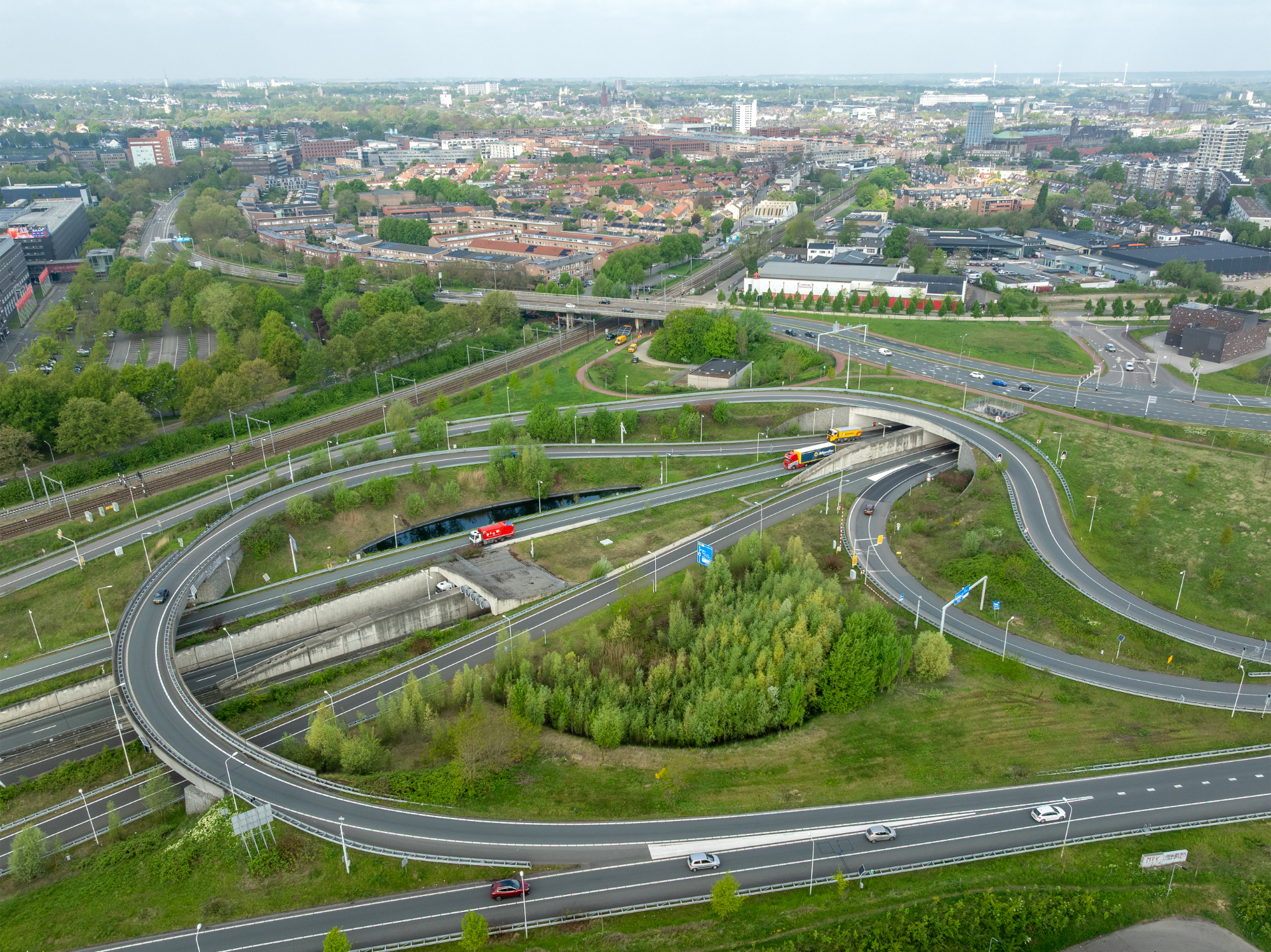
King Willem-Alexander Tunnel (A2/N2)
The King Willem-Alexander Tunnel is a double-decker tunnel and forms part of both the A2 motorway and the N2 expressway. The tunnel is located in the city of Maastricht and is 2.3 km long and 4.70 m high.
First double-decker tunnel in the Netherlands
We monitor the tunnel 24 hours a day from the traffic control centre in Helmond.
The King Willem-Alexander Tunnel consists of two pairs of tunnel tubes, one above the other, making it the first double-decker tunnel in the Netherlands. Local traffic on the N2 motorway uses the upper two tunnel tubes. Traffic on the A2 motorway towards Eindhoven or Liège travels through the lower two tunnel tubes.
You will no longer encounter any traffic lights on the route from Amsterdam to Marseille.
The tunnel opened in 2016, significantly improving traffic flow, accessibility and quality of life in Maastricht. Thanks to the tunnel, 80% of all traffic now travels underground rather than through Maastricht. What’s more, there are now no more traffic lights on the Amsterdam-Marseille route. A park-like environment has been created on the site of the old A2/N2 motorway: the Groene Loper (Green Carpet). This is a recreational area where 1,800 trees have been planted, connecting the east and west of Maastricht.

Construction of the King Willem-Alexander Tunnel
The King Willem-Alexander Tunnel was constructed between 2011 and 2016. Following the change of monarch in 2013, King Willem-Alexander was asked to lend his name to the tunnel. The construction required 12,000 cables and pipes, 300,000 m³ of concrete and 120 million kg of asphalt. To build the tunnel, 1.4 million m³ of soil, gravel and marl were excavated. This is comparable to a line of sand trucks stretching from Maastricht to the Côte d'Azur. In addition, 21 other structures, such as flyovers, viaducts, cycle tunnels and ecoducts, have been built in the immediate vicinity (over a length of 6 km). These structures also improve Maastricht’s accessibility, traffic flow on the A2 motorway, road safety and quality of life in the immediate vicinity.
Traffic flow control in the King Willem-Alexander Tunnel
Traffic jams in tunnels are dangerous. We want to prevent this by regulating traffic flow through the tunnel. If lower speeds and closed lanes are not enough, we can also temporarily close one of the tunnel tubes (on the A2 or N2). This happens regularly during the morning rush hour southbound. This gives traffic at the exit just after the tunnel enough space to continue driving, preventing traffic jams in the tunnel.