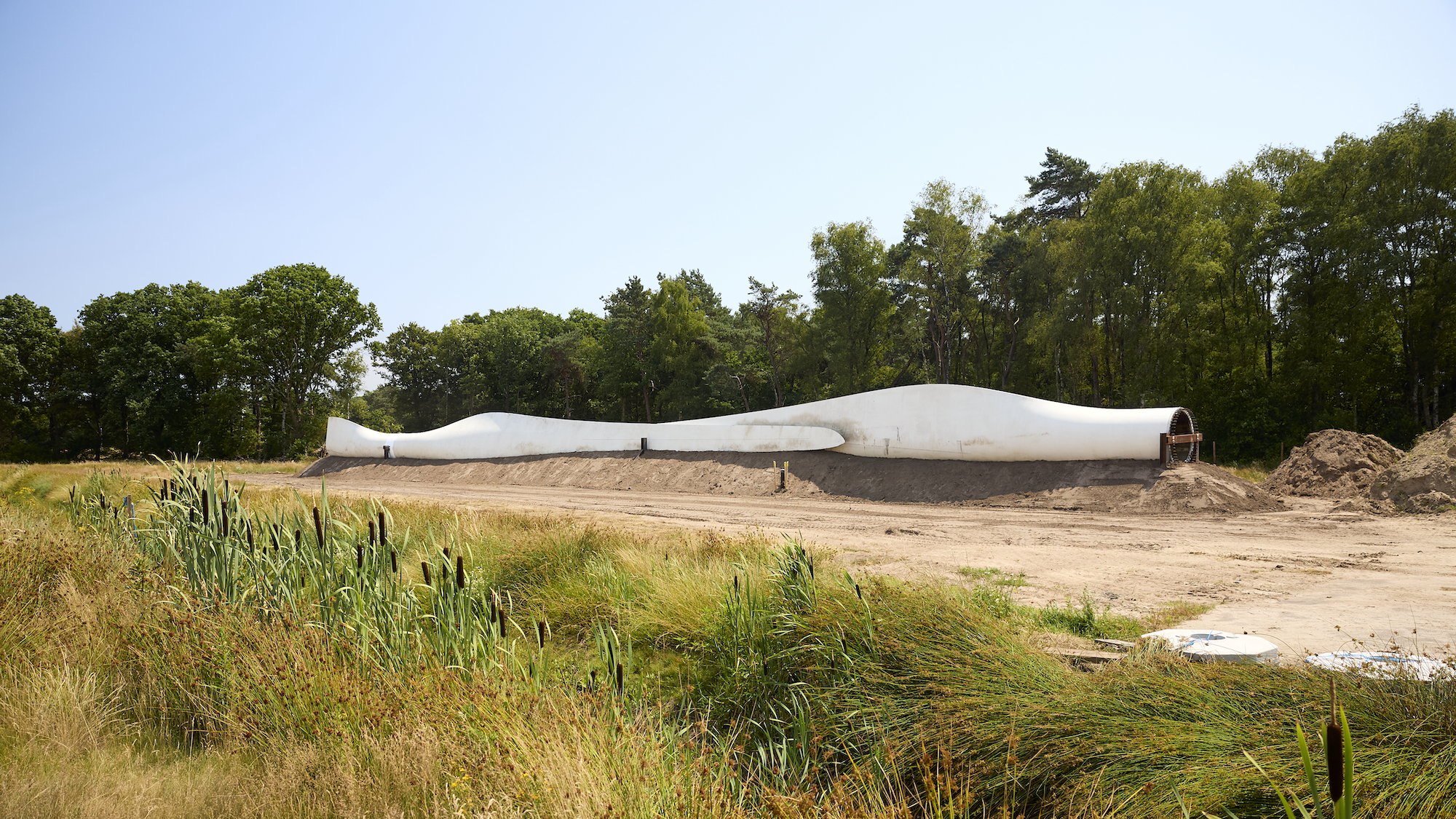
Blade Barrier shows promising results
Repurposed wind turbine blades perform as fully-fledged noise barriers: six months after its unveiling, the Blade Barrier at the InnovA58 test site shows that repurposed wind turbine blades can be a serious and circular alternative to traditional noise barriers.
Initial measurement results show that the innovative barrier achieves noise reduction comparable to that of a standard concrete noise barrier.
A Dutch world first
The Blade Barrier was unveiled on 2 July 2025 as a Dutch world first: the first noise barrier constructed from discarded wind turbine blades. The 60-m-long test setup is located along the A58 motorway near Oirschot, The Netherlands, and will be monitored until the end of 2026 within InnovA58, the Rijkswaterstaat infrastructure testing ground.
Noise performance comparable to concrete barrier
The first measurement results show that the Blade Barrier achieves good noise reduction results. The noise barrier, constructed from two whole turbine blades and a sawn section, varies in height between 3 and 4 m. Evaluation using scientific models shows that the Blade Barrier is acoustically comparable to a traditional noise barrier approximately 3,3 m high.
The noise research on the Blade Barrier was carried out by the companies M+P and Demcon, commissioned by Rijkswaterstaat, the executive agency of the Ministry of Infrastructure and Water Management in the Netherlands.
Rijkswaterstaat is pleasantly surprised by the results, Willem Jan van Vliet (noise control expert): ‘The results clearly demonstrate the screen effect of the Blade Barrier. Based on this, we now know how the screen can be modelled in a regular road traffic noise study.’
This means that one of the most important assessment criteria has now been demonstrated in broad terms: noise performance. Its realisation in July 2025 also demonstrated its feasibility. Monitoring will continue until the end of 2026, when the results of the other criteria (financial impact, safety & maintenance and sustainability) will follow.
Circular alternative to a growing waste problem
The Blade Barrier is an initiative of start-up Blade–Made, which focuses on the high-quality secondary use of wind turbine blades and other composites from decommissioned wind farms. These blades are difficult to recycle and constitute a growing waste stream worldwide.
Using the blades as a secondary building material in large-scale infrastructure projects offers the wind industry a sustainable solution for complex residual waste streams. The construction sector saves cement and steel, thereby reducing the pressure on the environment. In this way, it creates benefits on both sides.
The noise barrier is in line with Rijkswaterstaat's ambition to become completely climate-neutral and circular.
InnovA58 as a living testing ground
Rijkswaterstaat is participating in the project through InnovA58 with the test location, knowledge and co-financing. The Blade Barrier fits within the ambition to work towards sustainable and circular infrastructure objects that are also applicable in everyday practice.
With the first positive results, InnovA58 also wants to inform other road authorities, such as municipalities and provinces, about the possibilities of circular noise barriers. The Blade Barrier shows that the reuse of complex waste streams, such as wind turbine blades, can lead to fully-fledged, functional and scalable infrastructure solutions with a lower environmental impact.
The test setup was realised in collaboration with construction company Dura Vermeer, which was involved in the development and implementation from the start. The province of North Brabant is also involved through a financial contribution from the Circular Breakthrough Projects Programme.