

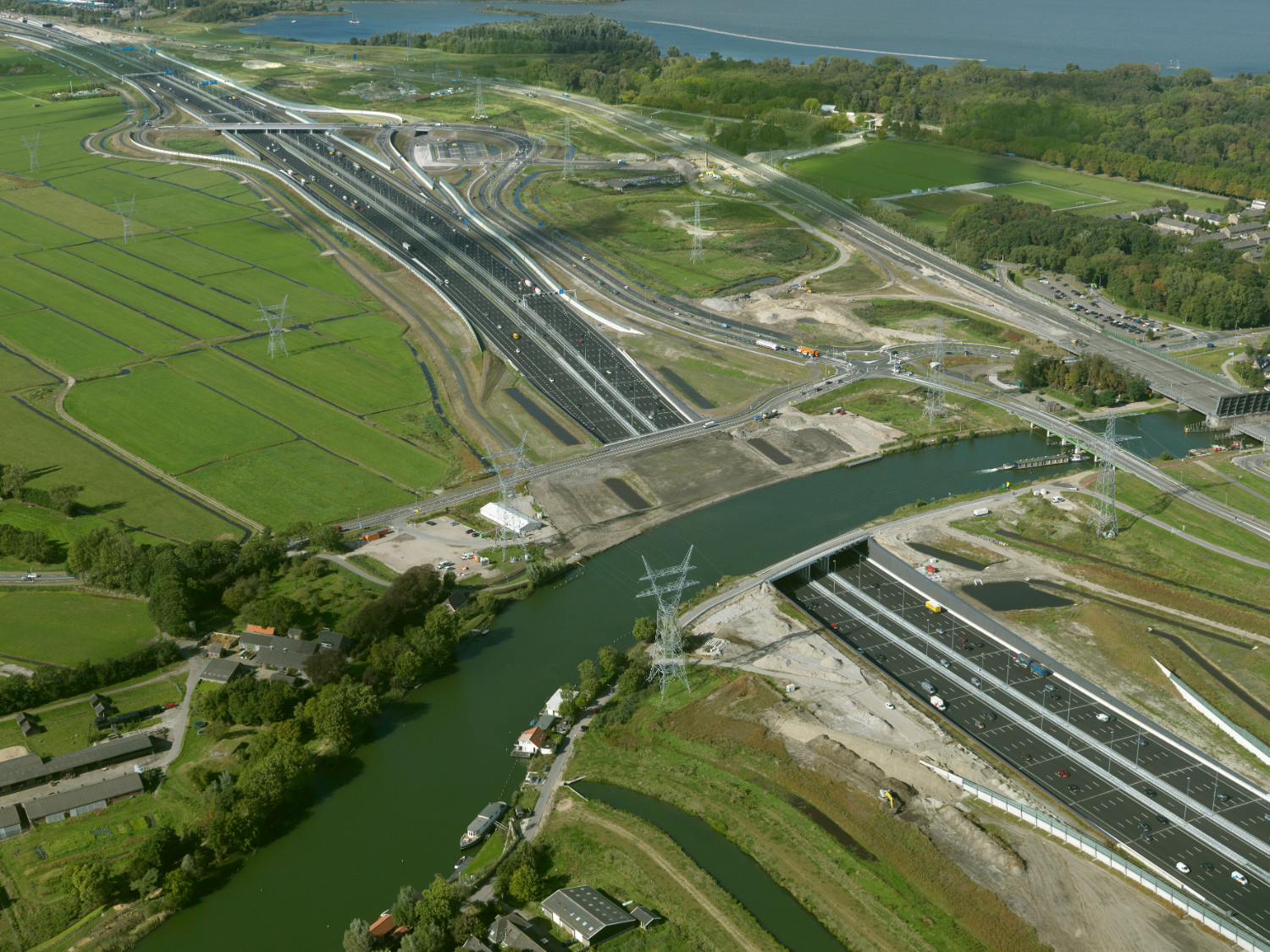
Aqueduct Vechtzicht
The widest aqueduct in Europe is located near Muiden: 65 metres wide and approximately 620 metres long, with a total of 12 lanes. The closed section of the aqueduct is approximately 194 metres long. The aqueduct is part of the Schiphol-Amsterdam-Almere Project.

5,300 pile foundations are required to support the aqueduct.
An aqueduct is a bridge for a watercourse, such as a river, canal or spring. Examples include giant aqueducts built by the Romans. They used these water bridges to carry watercourses over lower-lying areas, such as valleys. The aqueducts built at that time are still in use today. Nowadays, aqueducts are mainly used to provide free passage for shipping.
The Romans already built enormous aqueducts.
Tunnel vs aqueduct
The aqueduct is part of the A1 motorway and is founded on piles. A total of more than 5,300 piles were used.
The structure consists of 57,000 m³ of concrete and 8,000 tonnes of reinforcing steel. The construction required 120,000 m³ of earthworks.
An aqueduct over a motorway or expressway looks very similar to a tunnel, but it is not. The main difference is that in an aqueduct, the water flows through a concrete trough, whereas a tunnel simply runs underneath the original waterway.
With the new aqueduct at Muiden, the Vecht river now has more space again, as the bridges have been removed. Road traffic and shipping traffic no longer interfere with each other, as car traffic now passes under the Vecht. On the west bank of the aqueduct, there is an eco-passage with wet and dry strips of land.
