

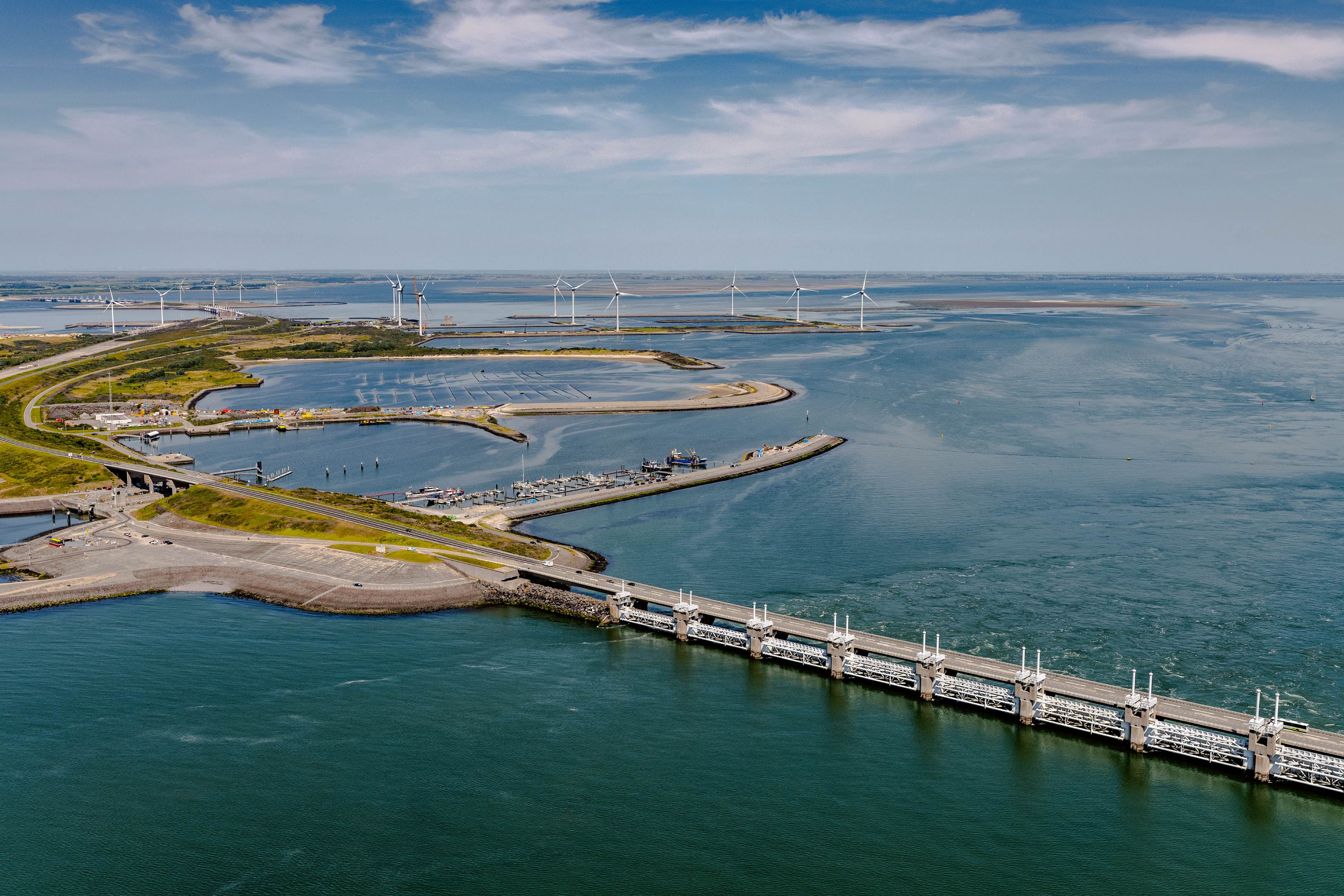
Our country is a country of resilience. For centuries we have faced increasingly higher levels of water. And with each challenge we come out on top. By constantly looking ahead, we're the safest delta in the world. Thirty years ago, Rijkswaterstaat built the Oosterschelde storm surge barrier. Our country's largest Delta Works: no less than nine kilometres long. We did this for our own safety, and for that of future generations. An enormous task that took us about ten years to complete. Step by step, a solid foundation emerged beneath our feet. We showed real backbone, and our years of hard work produced an impressive result. It may seem perfectly normal... the Oosterschelde storm surge barrier protecting hundreds of thousands of people against high water. But that it's possible with just a push of a button is simply amazing. To keep it this way, after 30 years of faithful operation the Oosterschelde storm surge barrier is undergoing a major renovation. We will wrap the gates and give them a new protective layer. Together with expert partners we work on the safety, accessibility and quality of life in the Netherlands. Together, we build the Netherlands.
Eastern Scheldt Barrier
The Eastern Scheldt Barrier is the crown jewel of the Delta Works. This imposing, 9 km structure protects the Netherlands from flooding by closing off the Eastern Scheldt (Oosterschelde) when high water threatens.
9 km long, 3 of which can be closed
The Eastern Scheldt Barrier connects the islands of Schouwen-Duiveland and Noord-Beveland in the province of Zeeland. Built between 1976 and 1986, it is the largest and most extensive storm surge barrier in the Netherlands.
What is the Eastern Scheldt Barrier?
The Eastern Scheldt Barrier is an open, movable flood defence structure located in the Eastern Scheldt estuary. Originally, a solid dam was planned, but the current design was chosen to preserve the natural environment and protect the fishing industry. As a result, tides continue to ebb and flow, and the water remains saline.
The barrier consists of concrete piers with sluice gates between them. Under normal conditions, the gates remain open. They are only closed during periods of exceptionally high water.
Why was the Eastern Scheldt Barrier built?
The barrier was constructed in response to the North Sea flood of 1953, which devastated large parts of Zeeland, South Holland and North Brabant, much of which lies below sea level.
In the aftermath of this disaster, the Netherlands resolved to strengthen its defences against the sea. This led to the creation of the Delta Works, a series of 13 major flood defence projects. The Eastern Scheldt Barrier is one of the most important of these and plays a crucial role in protecting the country from high water.
Construction of the Eastern Scheldt Barrier
At the time of its construction, it set new standards in scale and complexity – and it remains unparalleled today. It is widely recognised worldwide as a landmark in hydraulic engineering.
Construction began in 1976 and took 10 years to complete. It was one of the largest and most complex hydraulic engineering projects ever undertaken in the Netherlands. Thousands of people worked on the project around the clock.
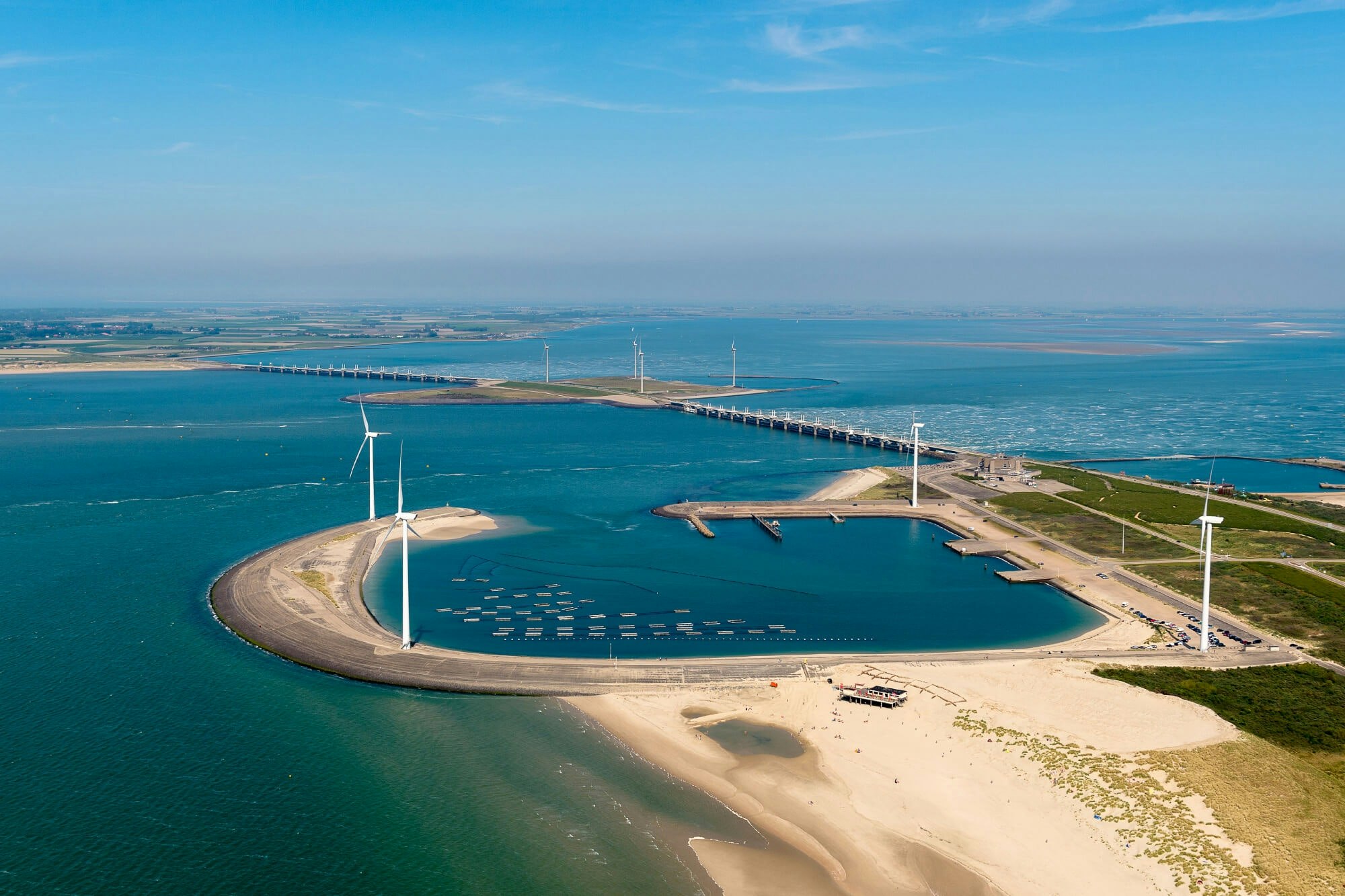
Facts and figures about the Eastern Scheldt Barrier
The Eastern Scheldt Barrier:
- is closed once a year on average
- is designed to withstand a flood that is statistically unlikely to occur more than once in 4.000 years
- has 65 colossal piers, separated by floodgates that are approximately 42 m wide and 6 to 12 m high, each weighing between 260 and 480 tonnes
Special team for operation
Rijkswaterstaat operates the barrier with a dedicated team, supported by the Hydro Meteo Centre. This water management centre provides essential data and forecasts based on measurements and predictive models.
The Eastern Scheldt Barrier is closed when the water level is expected to rise to 3 m above NAP
Closing the barrier
The barrier is closed when water levels are expected to rise above three metres above NAP (Normaal Amsterdams Peil, roughly equivalent to the average North Sea level).
At the push of a button, all 62 floodgates are lowered from the control centre at ir. J.W. Topshuis on the artificial island of Neeltje Jans. The entire process takes around 75 minutes. An automated emergency system is also in place, although it has never been needed.
Video: the largest of the Dutch Delta Works
Thanks to a forward-thinking approach, the Netherlands now has the safest delta in the world. The Eastern Scheldt Barrier was officially opened on 4 October 1986. Since then, it has become a symbol of Dutch hydraulic engineering excellence, showcasing what can be achieved through knowledge, craftsmanship, collaboration and innovation. The barrier remains an essential part of the Netherlands' flood defences.
Spanning nine kilometres, the Eastern Scheldt Barrier is the largest of the Delta Works structures. It protects hundreds of thousands of people from flooding.
Maintenance and the future
Although the Eastern Scheldt Barrier is ageing, it must continue to function reliably. Regular inspections and maintenance ensure its ongoing performance. This includes checks of the control system, the emergency closure system and the electrical installations. Most maintenance work takes place between April and September, outside the storm season.
In the coming years, Rijkswaterstaat will also carry out major maintenance.
We are also looking further ahead. The climate is changing, sea levels are rising, and weather events are becoming more extreme. We expect that we will need to close the barrier more often in future. Research is therefore underway to determine whether the current design will continue to meet long-term requirements or whether modifications will be needed. This will help ensure the barrier remains effective for generations to come.
Plan your visit to the Eastern Scheldt Barrier
The Eastern Scheldt Barrier is freely accessible. The N57 motorway runs across the barrier, with a cycle and footpath alongside it. The former construction island of Neeltje Jans has been incorporated into part of the Eastern Scheldt National Park reserve (Dutch website). Several viewpoints offer excellent views of the barrier and its surroundings. You can also visit Deltapark Neeltje Jans to learn more about the Delta Works.
The Watersnoodmuseum (Dutch website) in Ouwerkerk is also worth a visit. It tells the story of the 1953 North Sea flood and the Delta Works, and highlights efforts to strengthen the Netherlands’ flood defences.