
Climate-adaptive roadside management for biodiversity and safety
Over the past six years, the LIFE IP All4Biodiversity programme has shown that strengthening biodiversity works best when you start from the landscape itself. By setting shared ambitions, working together in a targeted way and tailoring measures to local conditions, the programme has generated practical solutions that deliver real impact.
Since 2020, this approach has been tested across locations throughout the Netherlands, building a strong body of experience and proven practices.
Workshop on climate-adaptive roadside management
The programme concluded on 20 November 2025 in Katwijk. The day featured a plenary programme highlighting key outcomes with a marketplace of LIFE IP partners and eight workshops that enabled participants to explore specific themes in depth.
This report focuses on the workshop on climate-adaptive roadside management for biodiversity and safety. Led by Toine Morel of Rijkswaterstaat, the session shared insights from research and practice on how roadside verges can be managed more effectively in a changing climate.

Research
As a participating party, Rijkswaterstaat contributed a multi-year research project to the LIFE IP All4Biodiversity programme in the form of a PhD study investigating the impact of climate change on biodiversity and ecosystem services in roadside verges. In the Netherlands, these verges cover around 2% of the total land area.
We manage a network of over 3.000 km of main roads and 188 km² of verges and ditches. Around 70% of these are herb-rich grass verges, which are mown annually to maintain road safety and visibility. Regular mowing also helps reduce the risk of verge fires, as dry grasses and flowers can ignite easily during hot, dry periods.
Roadside verges as valuable habitats
Grass verges along Dutch roads are important habitats for a variety of plants, insects and animals. Around 50% of all native plant and insect species, including rare and red-listed ones, can be found in these verges.
Well-designed mowing regimes can therefore support both safety and biodiversity. Flower-rich grass verges, for example, develop stronger root systems, improving soil stability, reducing erosion and contributing to safer roadsides.
Growing pressure on safety and biodiversity
Research shows that both safety and biodiversity in roadside verges are increasingly threatened as the climate changes. Warmer, drier summers have led to a sharp rise in verge fires. In the summer of 2018 alone, more than 200 such fires occurred along national roads.
At the same time, biodiversity is declining as competitive grass species become more dominant and overall biomass increases, further elevating fire risk. Whereas previously grass growth largely stopped in winter, milder conditions now allow growth to continue for much of the year.
Win-win situation through adapted mowing management
In response, Rijkswaterstaat, Wageningen University & Research (WUR) and LIFE IP All4Biodiversity investigated how mowing strategies could be adapted to address both fire risk and biodiversity loss.
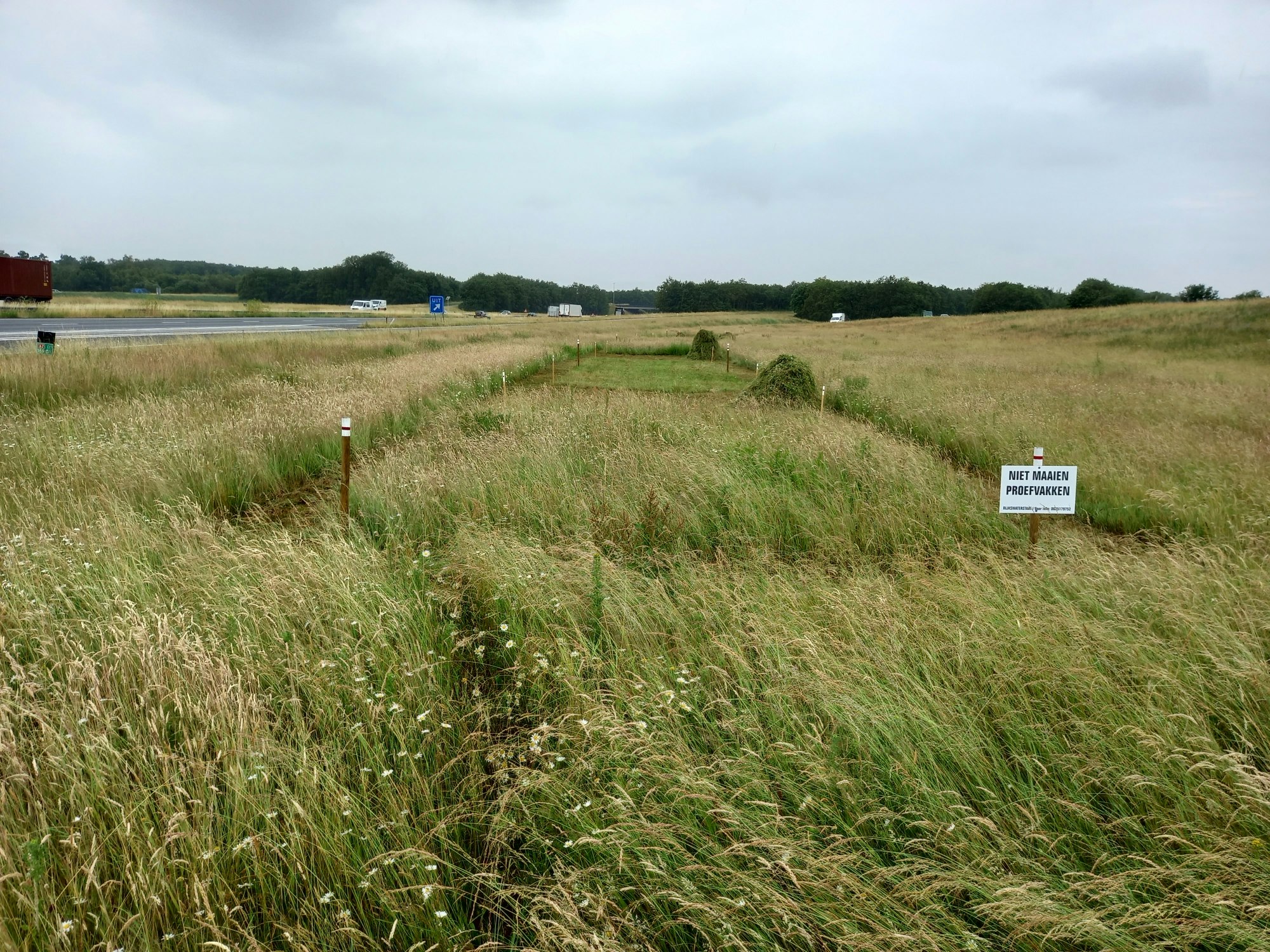
As part of this work, PhD researcher Wiene Bakker conducted mowing experiments to compare the effectiveness of different management strategies. The results show that climate-adaptive mowing can deliver clear benefits for both safety and nature.
For highly productive, grass-dominated verges, mowing twice a year proved most effective. Less productive verges with slower vegetation growth only need to be mown once a year. Preventive mowing and the removal of clippings before summer reduce fire risk and stimulate biodiversity.
Delaying the second mowing round until late September or early October further enhances these positive effects.