

All4Biodiversity: improving our natural reserves
The Netherlands has a rich variety of natural habitats.
In the EU-LIFE IP All4Biodiversity pprogram partners worked together in different pilots to restore biodiversity in Natura2000 areas. The objectives and approach of the program aligned with the challenges faced by rural areas, including water quality, nitrogen reduction, greenhouse gas emissions, and economic development.
This area-oriented approach was carried out in an integrated manner to achieve Natura 2000 objectives while also considering quality of life, health, landscape, climate, and the balance between economy and ecology.
All4Biodiversity has developed a toolbox and training methods (in Dutch) to organize the process in a harmonized and efficient manner.
Impact of climate change on biodiversity in road verges
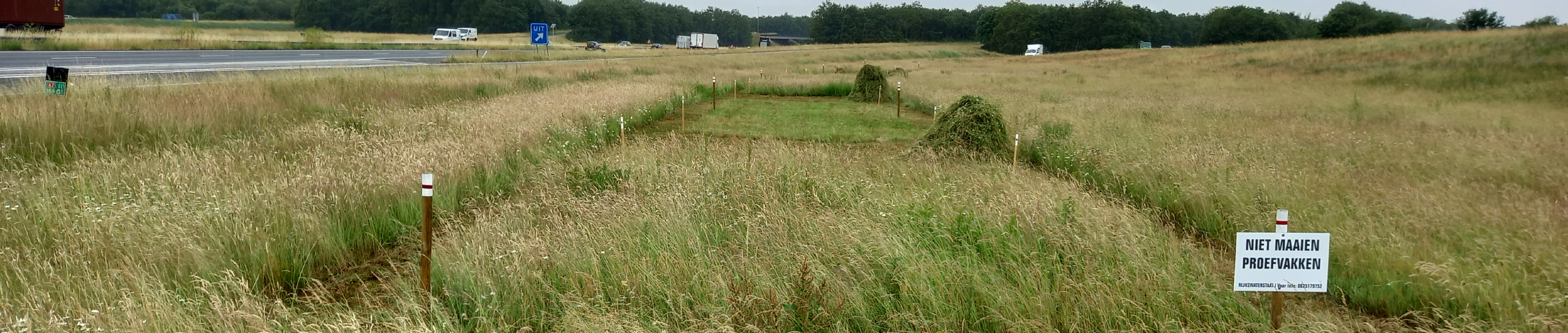
In the Netherlands, road verges are mown annually with hay removal. Mowing prevents the encroachment of woody plants, thereby preventing succession to other vegetation types and providing safety for road users. Although mowing primarily occurs for road safety and road stability, mowing also provides opportunities for biodiversity and nature.
This management has developed a huge network of species-rich grasslands sheltering a range of plants, insects and small mammals. As partner of the All4Biodiversity programme, Rijkswaterstaat teamed up with Wageningen University & Research (WUR) to find out which type of management can both accommodate the effects of climate change on road safety and recover the loss of plant- and insect biodiversity in our roadside verges.
The effects of climate change and mowing regimes on biodiversity and ecosystem services in road verges were studied with four complementary approaches, analysis of available data, field experiments, drought experiments and integration of the results.
Analysis of the data showed that biodiversity of plant species in road verges has declined since 2004 and small species, especially forbs and short lived species, have been replaced by taller species, especially grasses.
Winter warming leads to less biodiversity, and more tall, competitive species that have the ability to suppress other species through shading. Negative effects of winter warming were stronger in areas subject to higher N deposition.
A comprehensive report has been published that outlines the effects of management practices and climate change on biodiversity and ecosystem services of grassland road verges.
Dissemination of the results
Overall the results show that biodiversity in road verges was threatened by climate change, but that adjustments in road verge management can at least partially reverse this trend, while also positively impacting road safety and most of the ecosystem services.
For road verges with a high biomass production, mowing 2 times per year in June and late autumn, with hay removal and at low mowing height, was assessed to be most beneficial to safety (reduced risks on roadside fires), biodiversity and ecosystem services.
For most low productive road verges tailored management and high mowing quality (adequate and quick hay removal and low mowing height) is likely most important.
The key message of the LIFE IP All4Biodiversity programme is that effective collaboration does not occur automatically. If we once again view biodiversity as a shared responsibility across the entire landscape, the continuation of LIFE IP All4Biodiversity can genuinely support the long-term restoration of nature.
Project period
2020 - 2026
European programme
Life IP All4Biodiversity
Project website
Partners
Province of South Holland (NL), Samen voor Biodiversiteit (NL), Province of Friesland (NL), Province of Gelderland, Province of North Brabant, Province of Limburg (NL),
Ministry of Agriculture, Fisheries, Food Security and Nature, BoerenNatuur, Natuurmonumenten (NL), Staatsbosbeheer (NL), Vogelbescherming (NL), Naturalis.